


EQ Over IQ: The One Skill That Will Determine Your Child's Success More Than Grades
"My daughter got straight As in her final year of school. She was the top student in her class. She got into university on a full scholarship. And then she fell apart because nobody had ever taught her how to deal with failure, conflict, or people who did not like her." Wanjiku, Kenyan
This story plays out in homes across Africa every single year. A child with outstanding grades and very little idea of how to handle real life when it stops cooperating.
Academic excellence the thing we have spent years building, celebrating, and sacrificing for does not, by itself, produce a person who is equipped to handle life. It never has. We just did not talk about it much.
What does prepare a child for life? Research spanning five decades, across six continents, involving millions of young people, points to the same answer: emotional intelligence. The ability to recognise, understand, manage, and use emotions in yourself and in the people around you is the single greatest predictor of long-term success, wellbeing, and healthy relationships.
And most of it is not being taught. Not in classrooms. Often not at home. Not because parents do not care. But because they were never taught it either.
This post covers what emotional intelligence actually means for children aged 6 to 17, why it matters more than most parents realise, and what you can begin doing this week whether your child is 6 or 17.

What Emotional Intelligence Actually Is and Is Not
Emotional intelligence is one of the most misunderstood ideas in parenting and education. Before we can build it in our children, we need to be honest about what we are actually talking about.
What EQ is NOT: Being emotional, dramatic, or over-sensitive. Always being calm or never getting angry. Weakness or softness. A Western self-help concept with no roots in African life and culture.
Psychologists Peter Salovey and John Mayer, who first defined emotional intelligence in 1990, described it as the ability to perceive emotions accurately, use emotions to support clear thinking, understand what emotions mean, and manage them effectively. In practical terms for a child aged 6 to 17, EQ looks like this:
Self-Awareness
Knowing what you are feeling and why and understanding how your emotions affect your thinking and behaviour.
Self-Regulation
Managing your emotional responses not suppressing them, but choosing how and when to express them. The 8-year-old who is angry but takes a breath before responding.
Empathy
Genuinely understanding what another person is feeling. The child who notices a classmate is having a hard day without being told.
Social Skills
Navigating relationships with confidence and care. Making friends. Handling conflict. Advocating for yourself without aggression. Receiving criticism without collapsing.
Motivation
Pursuing goals with persistence even when it is hard — not for external reward alone, but because of a genuine sense of purpose and belief in their own capacity.
Emotional Vocabulary
Having words for what you feel beyond happy, sad, and angry. A child who can name an emotion with precision can manage it far more effectively than one who cannot.
EQ is not about feeling everything. It is about understanding what you feel, choosing how you respond, and remaining present enough to do the same for the people around you.
The Research: Why EQ Matters More Than IQ
The case for emotional intelligence is not built on opinion. It is one of the most robust findings in modern psychology, replicated across cultures, age groups, and decades of research. Here is what the numbers say.
The most important finding for parents: EQ is teachable. Studies show that structured EQ work with children aged 6 to 17 produces measurable improvement in as little as 8 to 12 weeks. Your child is not born emotionally intelligent or emotionally unintelligent. They become one or the other based on what they are taught, what they observe, and what their environment makes possible. (Journal of Child Psychology, 2023)
What Is Making the EQ Crisis Worse for Children Today
Emotional intelligence has always required deliberate effort to build. But today's children face specific pressures that are actively working against its development pressures that did not exist for previous generations at anywhere near the same scale.
1. What Screens Are Doing to Emotional Development
Children develop empathy by reading faces. They develop self-regulation by experiencing boredom, frustration, and conflict and learning to navigate through them. They develop social skills by working through real human interactions where things go wrong and must be repaired.
Screens short-circuit all of this. A child spending four to seven hours daily in digital environments is in a space with no faces to read, no boredom to tolerate, no real conflict to resolve. The emotional development muscles are simply not being used.
2. Academic Pressure Pushing Emotional Life to the Side
Across Kenya, Nigeria, Ghana, Uganda, and most of Africa, children face extraordinary academic pressure from very early ages. In many families, a child's emotional life is quietly deprioritised in favour of performance.
A child who is crying about a friendship problem hears "you need to focus on your studies." A child anxious about a presentation hears "just perform and stop worrying." A child who is angry about something unfair hears "this is not the time for emotions."
That message, received thousands of times across childhood, produces one clear lesson: your emotional life is an inconvenience. Handle it privately. Do not let it interfere with what matters.
This produces adults who are extraordinarily capable of performing under pressure — and completely unable to process what they feel while they are doing it. We see this pattern in our coaching work constantly.
3. The Shrinking of the Extended Family
In traditional African family structures, children grew up embedded in extended family systems. Grandparents, aunts, uncles, cousins, and community elders provided multiple models of emotional behaviour, multiple relationships in which to practise empathy, and multiple adults who knew a child well enough to notice when something was wrong.
Urban migration, nuclear family structures, and increasingly digital social lives have stripped many children of this ecosystem. A child in a Nairobi apartment block or a Lagos flat may have far fewer emotional models available than a child growing up in a multigenerational compound ever did. The informal emotional scaffolding that communities used to provide quietly and automatically is no longer there for most urban African families.
4. The EQ Gap Between Boys and Girls
Research consistently shows that girls receive more explicit emotional coaching in childhood than boys. They are asked more frequently about their feelings. Emotional expression is more socially acceptable. They get more practice.
Boys, by contrast, are more frequently taught to suppress emotional expression particularly vulnerability, sadness, and fear. The consequences emerge in adolescence and adulthood as emotional dysregulation, aggression, poor mental health outcomes, and relational difficulties.
The numbers are stark: Boys are 3 times more likely than girls to be told to "stop being emotional" or "toughen up" in childhood. Men account for 75% of suicide deaths globally, a statistic strongly linked to emotional suppression and the inability to ask for help. (UNICEF Global Parenting Norms Study, 2022 and WHO Mental Health Report, 2023)
This is not about making boys more like girls. It is about giving every child, regardless of gender, the full range of emotional tools they need to navigate life.
Build Your Child's Emotional Intelligence With Expert Support
At Sprout Life Skills, emotional intelligence is at the core of everything we do. We work with children aged 6 to 17 in person in Nairobi and online across Africa via SproutHub. Every programme is personalised to your child.
Explore Our ProgrammesEQ by Age: What to Build at 6, 10, and 14
Emotional intelligence development is not one-size-fits-all. Different capacities emerge at different developmental stages. Parents who understand this can be far more deliberate and effective about what they build and when.
Children are learning to name what they feel and beginning to understand that other people feel differently. This is when emotional vocabulary and basic self-regulation are built.
Emotional intensity peaks. Social dynamics become complex. Peer relationships become the primary emotional arena. Identity begins forming under enormous social pressure.
The emotional capacities built in childhood are tested against the real world. Identity, relationships, ambition, and failure all converge at once.
Ages 6 to 9: Building the Foundation
What to build: Emotional vocabulary beyond happy, sad, and angry. Basic self-regulation breathing, pausing. Early empathy through noticing what others feel.
What to avoid: Dismissing emotions ("you are fine, stop being silly"), shaming emotional expression ("big children do not cry"), or immediately solving every problem before your child has had a chance to feel it.
What it sounds like in practice at this age:
"You look frustrated. Can you tell me what that feels like in your body right now?"
"I wonder how your friend felt when that happened. What do you think was going through their mind?"
"It is okay to feel angry. Let us figure out what to do with that feeling."
Ages 10 to 13: Navigating the Turbulence
What to build: Self-regulation under pressure. Conflict resolution skills. The ability to distinguish between what they feel and what they do with that feeling.
What to avoid: Taking over their emotional problems. Minimising the intensity of what they feel ("it is just a school friendship, it does not matter"). Making their emotional struggles about you.
What it sounds like in practice at this age:
"I can see this is really painful. Tell me more before we figure out what to do."
"I am not going to tell you how to feel about this. But I am interested in what is actually going on for you."
Resist the urge to jump to solutions. The feeling needs to be fully heard before any problem can be solved.
Ages 14 to 17: Building Emotional Autonomy
What to build: The ability to manage their own emotional life without constant parental mediation. Empathy in complex relationships. Purpose the connection between who they are and what they want to build.
What to avoid: Treating every emotional expression as a problem to be fixed. Withdrawing because "they just want to be alone." Responding to their emotional intensity with matching intensity of your own.
What it sounds like in practice at this age:
"I notice you have been quieter this week. I am not going to push but I want you to know I am here and I am genuinely interested."
Then wait. Presence without pressure is the most powerful thing a parent of a teenager can offer.

The way a parent responds to a teenager's emotions teaches the teenager how to respond to their own.
What to Do This Week: Practical EQ-Building That Fits Real African Family Life
Everything below can be started tonight. No specialist training. No extra time. No resources beyond what you already have at home.
The Daily Emotion Check-In
This is the single most powerful EQ-building habit for any age. Five minutes at the end of every day. Ask your child four questions, in this order, and listen more than you speak:
"What was the best part of your day?"
This builds awareness of positive emotional experience and trains the mind to notice what is going well, not just what went wrong.
"What was the hardest part?"
This builds awareness of difficult emotional experience and normalises the idea that hard things happen to everyone, every day.
"How did you handle it?"
This builds self-reflection and self-regulation awareness. Your child begins to observe themselves as someone who responds to things, not just someone things happen to.
"Is there anything still sitting with you?"
This builds the habit of emotional inventory rather than suppression. The question says: your inner life matters, and we make space for it here.
Important: Do not turn the check-in into a problem-solving session. The goal is emotional awareness and the experience of being heard. Both are foundational to EQ. A child who is consistently heard does not need to act out to be noticed.
Model EQ Out Loud at Home
Children learn emotional intelligence primarily by watching the adults around them. The most powerful EQ intervention you can make costs nothing and takes less than a minute. Narrate your own emotional experience honestly, regularly, and without drama.
"I felt frustrated in a meeting today. I noticed I was getting irritated, so I took a breath before I responded. It helped."
"I was sad when I heard that news. I let myself feel it for a while, and then I called a friend."
"I am feeling a bit overwhelmed right now. That is not your fault I just want you to know why I seem distracted."
These moments ordinary, unscripted, honest teach children more about emotional intelligence than any book, lecture, or programme ever could. You do not need to be a perfect emotional role model. You need to be an honest one.
Teach the Feelings-Thoughts-Actions Link
One of the most important things you can teach a child at any age is this: a feeling is not an action. Feeling angry does not mean you hit someone. Feeling scared does not mean you run away. Feeling jealous does not mean you are a bad person.
When children understand the gap between what they feel and what they do with it, they gain enormous power over their own behaviour and their own life.
Try this with a real situation that comes up this week: "When that happened, what did you feel? What did you tell yourself about it? And then what did you do? Could you have done something different with that same feeling?"
Build Empathy Through Stories and Everyday Life
Empathy the cornerstone of emotional intelligence is built through practising another person's perspective. You can do this anywhere, any time, without any preparation at all.
During a film or TV show together: "What do you think that character is feeling right now? Why do you think they made that choice?"
After a conflict at school or home: "Before we talk about what you did, tell me what you think the other person was experiencing in that moment."
In everyday errands around Nairobi or wherever you live: "The mama mboga seemed tired today. I wonder what her morning was like." These small observations teach children that every person around them has a full inner life and that noticing it is a strength, not a distraction.
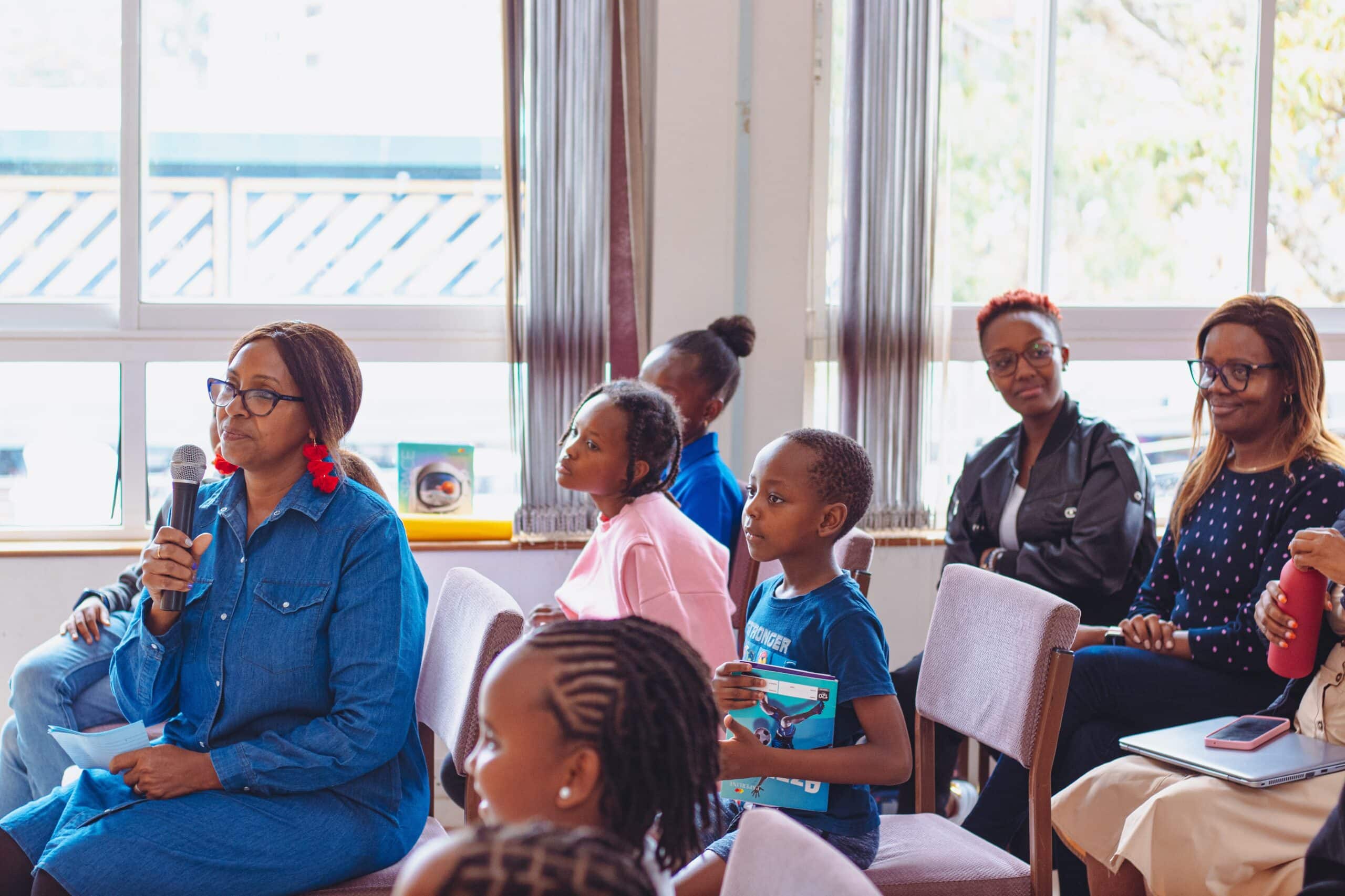
At Sprout, every coaching session builds EQ alongside communication confidence because you cannot truly have one without the other.
How Sprout Life Skills Builds EQ in Children Aged 6 to 17
At Sprout Life Skills, emotional intelligence is not an add-on. It is at the core of everything we do. Every programme, every coaching session, and every conversation we have with a child is grounded in the belief that EQ is the most important and most neglected development priority in childhood today.
We work with children globally through four coaching pathways, each designed for a different context, intensity, and need.
3-Month Coaching Programme
Structured, goal-oriented coaching over 12 weeks. Builds EQ, communication, confidence, resilience, and self-awareness. Delivered one-on-one or in small groups. For children who need consistent, sustained development support.
Holiday Coaching
Intensive skill-building during school holidays. Immersive and high-impact in a short window. Ideal for families who want focused progress during the holidays without a long-term commitment.
Home Coaching
We come to you. A Sprout coach works directly with your child in your home environment the place where life skills are most naturally applied and most deeply embedded.
SproutHub Online
Our virtual coaching platform. Flexible, accessible, and global. Children anywhere in Africa and beyond can access Sprout's life skills coaching through live sessions, resources, and community support online.
Every Sprout programme is personalised. We do not deliver a generic curriculum to a room full of children. We start with the child in front of us their specific emotional profile, their developmental stage, their family context, and their goals and we build from there.
For organisations: every school, NGO, and youth programme working with children aged 6 to 17 is working with children who have EQ gaps that affect their engagement, their learning, and their long-term outcomes. We partner with you to address those gaps in a way that amplifies the work you are already doing.
FAQs: Emotional Intelligence in Children Aged 6 to 17
What is emotional intelligence and why does it matter for children?
Emotional intelligence is the ability to recognise, understand, manage, and use emotions effectively nin yourself and in other people. For children, it is the foundation of healthy relationships, academic persistence, mental wellbeing, and long-term professional success. Research consistently shows EQ matters more than IQ in predicting life outcomes across every domain.
Can emotional intelligence really be taught to children?
Yes, and this is one of the most well-established findings in child development research. EQ is not fixed at birth or determined by personality type. It is a skill, built through consistent practice, deliberate modelling, and the right environment. Studies show measurable improvement in children aged 6 to 17 in as little as 8 to 12 weeks of structured EQ work.
My child seems emotionally mature already. Do they still need EQ coaching?
Emotional maturity and emotional intelligence are not exactly the same thing. A child can appear mature and still have significant gaps in self-regulation under pressure, empathy in complex situations, or the ability to manage relationships through conflict. EQ coaching is not remedial it is developmental. It builds capacity in every child, regardless of where they are starting from.
How is EQ built differently for boys compared to girls?
The core EQ capacities self-awareness, self-regulation, empathy, social skills, and motivation are the same for every child regardless of gender. What differs is that boys often need more deliberate permission and encouragement to express emotional vulnerability, because cultural norms have typically discouraged it. At Sprout, we are intentional about creating spaces where every child, regardless of gender, can develop the full range of emotional tools they need.
What is the difference between EQ and mental health support?
EQ coaching is a preventive, developmental intervention it builds skills and capacities in healthy children to equip them for life. Mental health support is therapeutic it addresses specific conditions or difficulties that require clinical expertise. The two are complementary. Strong EQ significantly reduces the risk of mental health difficulties, and mental health professionals frequently recommend EQ-building work alongside therapy.
Your Child's Emotional Intelligence Is Not Fixed It Starts With You
The most important thing to carry away from this post is simple. Your child's emotional intelligence is not a personality trait they were born with or without. It is a skill. And like every skill, it is built through what they are taught, what they observe, and what the environment around them makes possible.
The research is unambiguous: EQ is teachable at any age, with the right approach. Children who receive explicit, consistent emotional coaching build capacities that serve them for the rest of their lives in every relationship, every workplace, and every difficult moment they will face.
And the most powerful teacher they will ever have is not a coach, a therapist, or a school programme. It is a parent who shows up consistently. Who names what they feel. Who listens to what their child feels. Who creates a home where emotional life is taken seriously and not treated as an inconvenience.
The most emotionally intelligent adults were almost always raised by someone who treated their emotional life as real, important, and worth discussing. You can be that person. You are already more equipped than you think.
Start tonight. Ask the four questions. Share one honest moment from your own emotional day. Listen without immediately fixing. That is where it begins. And at Sprout Life Skills, that is exactly where we begin too.
Coming Up From Sprout:
- Next week: Why personal development starts before 18 and the one conversation most parents are having too late.
- Free resource: Our 10 Daily Habits for a Confident Child (ages 6 to 17) is available now. Send HABITS via WhatsApp or Instagram DM to receive it directly.
- Sprout coaching: If you want to explore which Sprout programme is right for your child, reach out directly. We will have a conversation no pressure, no obligation.
- Organisation partnerships: Schools, NGOs, and youth organisations working with children aged 6 to 17 anywhere in Africa or globally we are open to collaboration.
Invest in the Skill That Matters Most
Our programmes help African children aged 6 to 17 build emotional intelligence, communication confidence, and real life skills rooted in who they already are. In person in Nairobi. Online across Africa via SproutHub.
Explore Our Programmes Try SproutHub OnlineResearch and Sources Referenced:
- TalentSmart Global Emotional Intelligence at Work Study (2023)
- Harvard Business Review — Emotional Intelligence and Workplace Performance (2022)
- CASEL — Social and Emotional Learning Research Summary and Meta-Analysis (2023)
- RAND Corporation — Return on Investment in Social and Emotional Learning (2022)
- Journal of Child Psychology — EQ Intervention and Development in Children Aged 6 to 17 (2023)
- WHO Digital Wellbeing and Screen Time Global Report (2023)
- American Psychological Association — Screen Time, Empathy, and Child Development (2023)
- UNICEF Global Parenting Norms and Emotional Socialisation Study (2022)
- WHO Mental Health Action Plan and Suicide Prevention Report (2023)
- Salovey, P. and Mayer, J.D. — Emotional Intelligence, Imagination, Cognition and Personality (1990)