


7 Life Skills Every African Parent Wishes They Had Taught Their Child Earlier
Why the gap between what schools teach and what life demands is widest on our continent right now.
"I raised my child to pass exams. I did not raise them to handle life. By the time I realised the difference, they were already an adult."
A Kenyan mother, 52
If you have ever said something close to this, or felt it even if you never said it out loud, this post is for you.
Across Africa, we are raising a generation that is arguably the most academically prepared in our continent's history. School enrolment is up. Literacy is improving. University graduates are multiplying. And yet, employers across Kenya, Nigeria, Ghana, South Africa and beyond consistently report the same frustrating finding: young people arrive with certificates but without the skills that matter most in real life.
This is not a failure of intelligence. It is a gap in what we chose, often unconsciously, to prioritise. And it is a gap that you, as a parent, have the power to close. Starting today.
Here are the 7 life skills most African parents wish they had taught earlier, rooted in research, grounded in our cultural context, and deeply relevant to the pressures your child faces right now.
1Emotional Intelligence (EQ): The Skill Africa's Job Market Now Demands
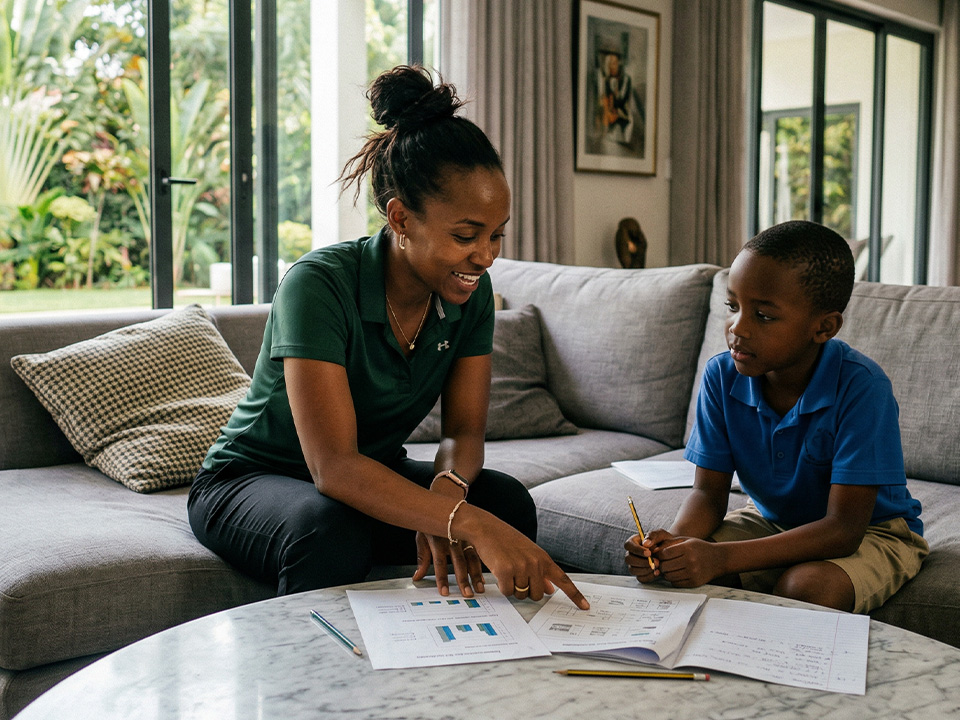
In many African households, emotions are managed through one of two approaches: suppress them ("stop crying, you are not a baby") or express them loudly in conflict ("I will beat sense into you"). Neither approach teaches a child how to understand, name, or regulate what they feel.
The consequences are showing up at scale.
91% of African HR managers cite poor emotional intelligence as a top reason young employees fail probation (McKinsey Africa Talent Report, 2023)
1 in 3 Kenyan teenagers reports feeling unable to talk to a parent about emotional struggles (Kenya National Bureau of Statistics Youth Survey, 2022)
68% of South African youth between 15-24 say they were never explicitly taught how to manage anger or anxiety (UNICEF South Africa, 2023)
The research is unambiguous: emotional intelligence predicts career success, relationship stability, mental health resilience, and even physical health outcomes more consistently than academic grades.
"EQ is not about being soft. It is about being strategic with your emotions rather than being controlled by them."
The African Cultural Context
Many of our cultural frameworks actively discourage emotional expression, particularly in boys. The Swahili concept of 'kujizuia' (self-restraint) is a genuine virtue, but it has been misapplied to mean 'never show what you feel.' The Yoruba value of 'ori' (personal destiny and wisdom) is deeply connected to self-awareness, but we rarely make that link explicit with our children.
We do not need to abandon our culture. We need to reclaim the parts of it that build emotional wisdom, and name what we are teaching.
💡 What You Can Do This Week
- Replace 'stop crying' with 'tell me what you are feeling right now.'
- Name emotions openly yourself. Children learn EQ by watching adults model it.
- Ask your child each evening: 'What was the hardest part of today? What felt good?' These two questions, done consistently, build emotional vocabulary.
2Communication & Confident Self-Expression: The Silent Epidemic
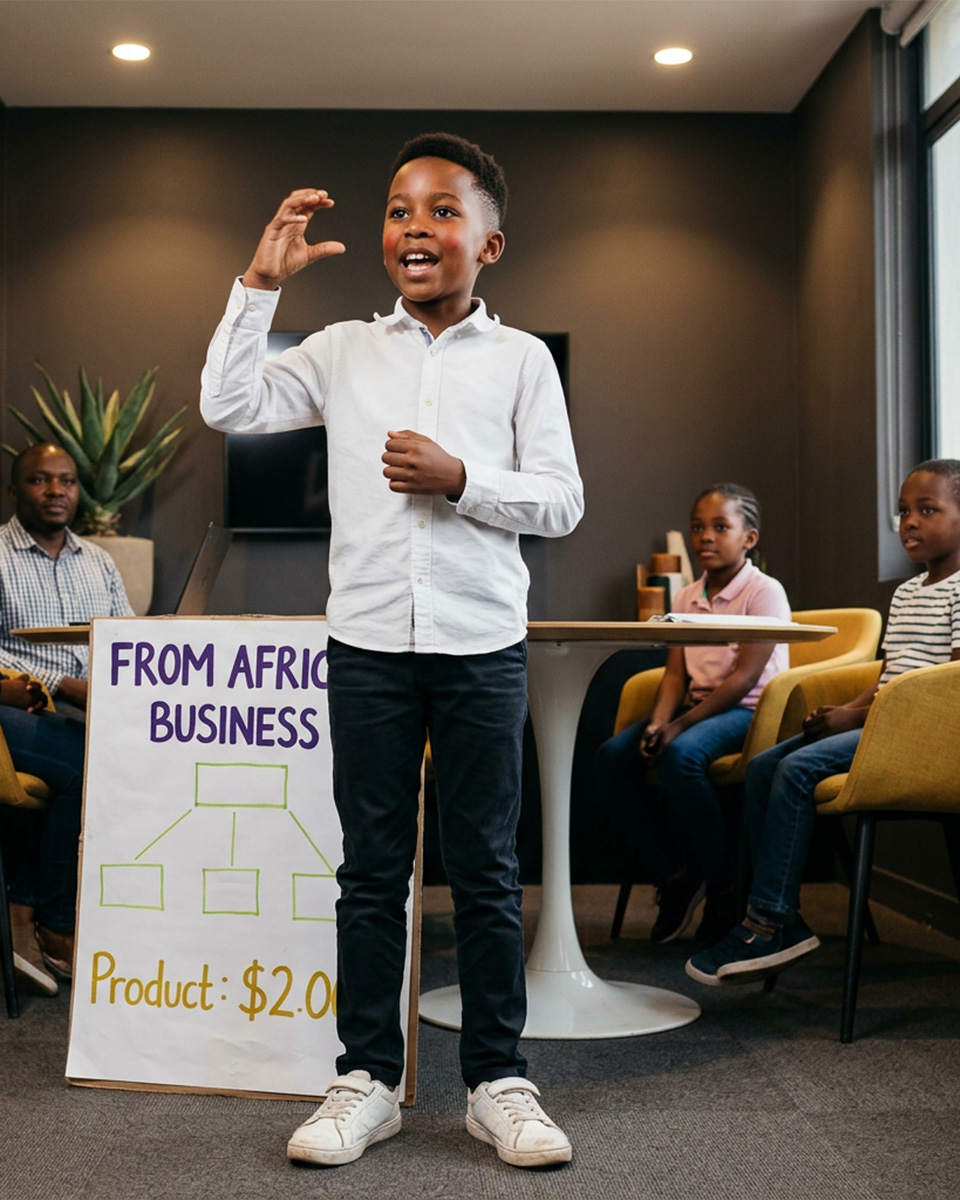
Here is a paradox playing out in homes across East and West Africa: we have raised children who can type 200 words per minute but cannot hold a two-minute conversation with a stranger without shrinking.
Digital fluency is not communication. Speaking up in a meeting, negotiating a salary, presenting an idea, advocating for oneself in a difficult situation, these require a different set of muscles. And we are not building them.
74% of Ghanaian employers say recent graduates cannot present ideas confidently in meetings (Ghana Employers' Association, 2023)
3 in 5 Nigerian university graduates report avoiding public speaking due to anxiety (University of Lagos Career Survey, 2022)
Only 12% of African secondary schools include communication skills or public speaking in their curriculum (African Union Education Report, 2023)
The Cultural Tension
In many African cultures, children are expected to be seen and not heard in the presence of elders. Deference is respect. Silence is wisdom. These are not bad values, they teach patience and listening. But they were never meant to produce adults who cannot advocate for themselves in the marketplace of ideas.
The child who was taught never to speak unless spoken to becomes the employee who never pitches their idea, never asks for a promotion, never challenges an unfair situation. We can honour respect for elders while simultaneously teaching our children to find their voice.
💡 What You Can Do This Week
- Give your child the floor during family time. Ask them to explain something they learned today, then listen without interrupting.
- Role-play difficult conversations: a job interview, saying no to peer pressure, asking a teacher to explain something again.
- Celebrate the attempt, not the performance. 'I noticed you spoke up in church today. That took courage.'
Help Your Child Build These Critical Skills
Our Complete Kids Public Speaking Course teaches African children ages 6-17 the communication skills, emotional intelligence, and confidence they need to thrive in today's world. Next cohort starts soon.
Complete Kids Public Speaking Course3Financial Literacy & Money Mindset: Breaking Generational Patterns
Money is one of the most taboo topics in African households. We discuss it in hushed tones, hide it from children, and often pass down unhealthy beliefs without realising it: 'Money is the root of all evil.' 'Rich people are corrupt.' 'We just don't have that kind of luck.'
Then we wonder why the next generation repeats the same financial struggles.
Only 23% of Sub-Saharan African youth between 15-24 demonstrate basic financial literacy (World Bank Financial Capability Survey, 2023)
78% of Kenyan adults say they received no financial education at home or school (FSD Kenya, 2022)
Over 60% of urban Nigerian families report that financial stress is the number one source of household conflict (EFInA Nigeria, 2023)
Financial literacy is not just about budgeting. It is about what your child believes they deserve, what they think is possible for them, and how they relate to the concept of building wealth over time. A child who grows up hearing 'we cannot afford it' without context learns helplessness. A child who grows up hearing 'here is how we make decisions about money in this family' learns agency.
💡 What You Can Do This Week
- Have an age-appropriate money conversation. For a 10-year-old: 'This is how our household budget works.' For a 15-year-old: 'Let me show you how a savings account earns interest.'
- Give them financial responsibility, a small budget to manage for a family errand.
- Challenge the money narratives they have inherited. 'In this family, we believe that money is a tool, not a measure of our worth.'
4Critical Thinking & Decision-Making: Protecting Against a World Designed to Mislead
We are raising children in the most information-saturated period in human history. And much of that information is false, manipulative, or designed to trigger an emotional reaction rather than an informed response.
From political misinformation circulating on WhatsApp family groups, to peer pressure disguised as social norms, to predatory financial schemes targeting young people, the ability to think critically is now a survival skill.
89% of Kenyan teenagers report regularly receiving misinformation via WhatsApp or social media (Aga Khan University Digital Literacy Study, 2023)
Only 31% of African secondary school students can identify a logical fallacy in an argument (African Development Bank Education Report, 2022)
The Obedience vs. Thinking Tension
African parenting has historically prized obedience. 'Do not question your elders.' 'When I say jump, you ask how high.' This produces compliant children, and adults who are vulnerable to manipulation by anyone who presents themselves as an authority figure.
Critical thinking is not disrespect. Teaching your child to evaluate a claim, ask for evidence, and question assumptions protects them. It does not undermine your authority. It builds theirs.
💡 What You Can Do This Week
- When your child shares news or a claim, ask: 'Where did you hear that? What do you think it means?' instead of accepting or dismissing it.
- Introduce the habit of asking three questions before accepting any information: Who said this? Why might they be saying it? What evidence supports it?
- Model critical thinking in real time. 'I saw something on social media today. Let me show you how I figure out if it is true.'
5Resilience & the Ability to Fail Forward: Rewriting Our Relationship With Failure
In cultures where family honour, academic reputation, and community standing are deeply intertwined with individual performance, failure carries enormous shame. A child who fails an exam does not just feel like they failed, they feel like they have failed their family, their ancestors, their community.
This is a crushing weight. And it is producing a generation that is terrified of trying anything they might not succeed at immediately.
54% of Ugandan teenagers say fear of failure stopped them from pursuing an opportunity they wanted (Makerere University Youth Wellbeing Study, 2023)
1 in 4 South African teens show signs of clinical anxiety linked to academic performance pressure (South African Child Gauge, 2022)
Nigeria ranks among Africa's highest for youth depression, with academic pressure cited as the leading trigger (WHO Africa Mental Health Report, 2023)
What Our Culture Gets Right, and Where It Breaks Down
African communal culture is extraordinary at holding people through grief and hardship, the concept of Ubuntu (I am because we are) is a profound resilience framework. But we often apply this communal support to external hardship (loss, illness, disaster) while leaving children alone to manage internal hardship (failure, shame, self-doubt).
Resilience is not built by telling a child to be strong. It is built by sitting with them in the hard moment, helping them extract the lesson, and demonstrating that their worth is not conditional on their performance.
💡 What You Can Do This Week
- Share a story of a time you failed and what you learned. (This is one of the most powerful things a parent can do.)
- Change the language around failure: 'This didn't work. What would you do differently next time?' replaces 'You have disappointed me.'
- Separate your child's identity from their results. 'You are not your grades. You are the person who is learning.'
Image Description: African teenager aged 14-17, reflective pose, journaling or studying, determined expression, overcoming challenge, supportive learning environment, natural light, South African or Kenyan setting, growth mindset visible
6Self-Awareness & Identity: Helping Children Know Who They Are Before the World Decides
Between the ages of 10 and 17, your child is actively constructing their identity. This is normal developmental psychology. What is not normal, or healthy, is doing that construction entirely under the influence of peer groups, social media algorithms, and cultural pressure, with no internal compass.
Self-awareness is the foundation of every other life skill. A child who knows what they value, what they are genuinely good at, what energises them and what drains them, that child makes better decisions, handles pressure better, and builds a life that actually fits them.
62% of African teenagers describe themselves using physical appearance or academic rank as their primary identity, not values, strengths, or interests (African Youth Survey, 2023)
Only 18% of Nigerian parents report regularly asking their children questions about their dreams, values, or sense of self (National Bureau of Statistics Nigeria, 2022)
The 'Be What Your Parents Expect' Pressure
In many African households, children grow up knowing exactly what they are expected to become, doctor, lawyer, engineer, pastor, the one who 'makes it', before they have any sense of what they themselves want. Cultural expectation is not inherently harmful. But it becomes harmful when a child has no room to discover their own identity beneath it.
A child who never gets to explore their own preferences becomes an adult who does not know themselves. And that disorientation, that hollow achievement, is the source of the midlife crisis we see so many educated Africans experience in their 30s.
💡 What You Can Do This Week
- Ask your child once a week: 'What is something you did this week that felt like the real you?'
- Give them permission to have opinions that differ from yours, on small things first. Build the muscle of having their own perspective.
- Discover their strengths together using simple observation of what they are naturally drawn to.
7Goal-Setting & Personal Vision: Moving Beyond Survival Mode
Much of African parenting is, understandably, oriented around survival. Many parents of today's preteens and teens grew up in households navigating genuine scarcity, of resources, of opportunity, of safety. The goal was not to thrive. It was to make it through.
But the world your child is entering is fundamentally different. They will have access to global opportunities, remote work, entrepreneurial pathways, and possibility that you never had. And they need a different mental model, one built not just around avoiding poverty, but around actively designing a life.
Only 29% of African secondary school students can articulate a clear personal goal beyond 'getting good grades' (UNESCO Education Futures Africa Report, 2023)
Youth unemployment across Sub-Saharan Africa sits at 13.1%, but underemployment (working below qualification or aspiration) affects an estimated 40-50% of youth (ILO Africa, 2023)
The Survival vs. Vision Mindset Gap
A survival mindset says: 'Get a good job. Be stable. Don't take risks.' A vision mindset says: 'Here is what I am building. Here is why. Here is the first step.'
Neither mindset is wrong, but only one of them is equipped for the economy your child will navigate. Goal-setting is not a Western concept. Our grandparents had enormous vision, they built communities, crossed borders, established institutions. We simply stopped making it explicit.
💡 What You Can Do This Week
- Sit with your child and ask: 'If everything worked out, what does your life look like at 25?' Write it down together.
- Help them set one 90-day goal, specific, achievable, meaningful to them (not to you).
- Review it together monthly. Celebrate progress, not just outcomes.
What This Means for You as a Parent
If you have read this far, you are already ahead. Not because you have done everything perfectly, none of us have, but because you are asking the right questions.
The gap between what schools teach and what life demands is real. It is measurable. And it is not going to be closed by the curriculum alone. But it can be closed, skill by skill, conversation by conversation, in the everyday moments of family life.
"The most important classroom is still family time. The most important teacher is still the parent who shows up consistently, honestly, and curiously."
You do not need a degree in psychology. You do not need money you do not have. You need intention, and a little guidance on where to start.
These 7 skills are where you start.
Enroll Your Child in Our Next Cohort
Our Complete Kids Public Speaking Course integrates emotional intelligence, communication skills, critical thinking, and personal development. Give your child the life skills they need to thrive, not just survive. Limited spaces available for our next cohort starting soon.
Complete Kids Public Speaking Course See Online Options📚 Research Sources Referenced:
- McKinsey Africa Talent Report (2023)
- Kenya National Bureau of Statistics Youth Survey (2022)
- UNICEF South Africa Youth Report (2023)
- Ghana Employers' Association Graduate Readiness Survey (2023)
- University of Lagos Graduate Career Survey (2022)
- African Union Education Progress Report (2023)
- World Bank Financial Capability Survey (2023)
- FSD Kenya Financial Access Survey (2022)
- Aga Khan University Digital Literacy Study (2023)
- Makerere University Youth Wellbeing Study (2023)
- WHO Africa Mental Health Report (2023)
- UNESCO Education Futures Africa Report (2023)
About the Author
Wairimu Ruhara is a personal development specialist working with children, preteens and teens across Africa. Her work supports parents, schools, and NGOs in building the life skills that no curriculum is teaching, but every child urgently needs. Follow Sprout Life Skills on LinkedIn, Instagram, TikTok, and YouTube for weekly content.